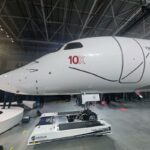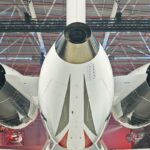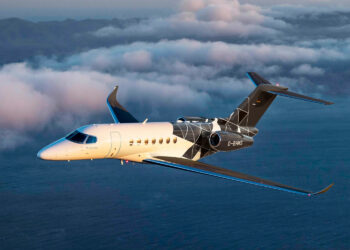

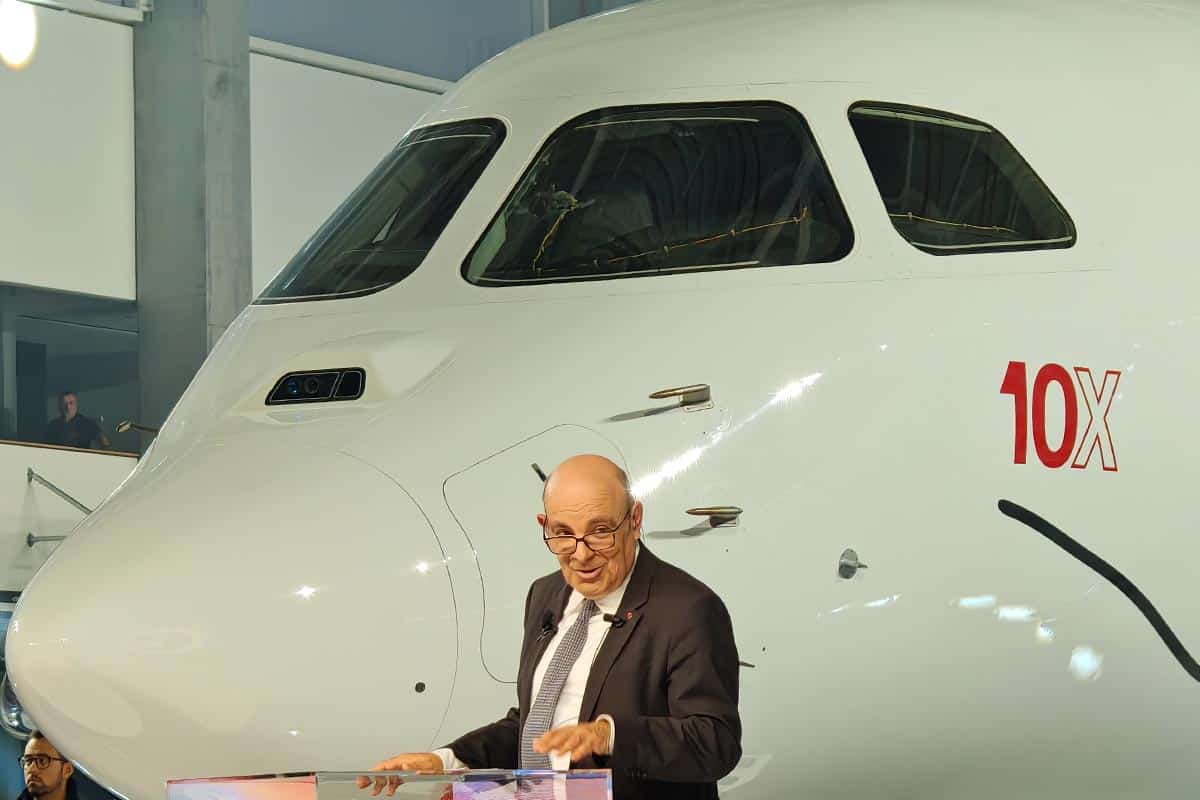
Dassault Aviation’s industrial site in Bordeaux-Mérignac was very much in celebration mode on the evening of March 10, 2026. The French manufacturer unveiled its long-awaited Falcon 10X, the new flagship of the Falcon business jet family, which will compete with the most prestigious aircraft on the market, and surpass them in many respects.
Never before has a civil aircraft from the French manufacturer been so ambitious, both in terms of external dimensions and, above all, with its very long range of 7,500 nautical miles (up to 13,890 km, 15 hours of flight) suitable for transpacific flights, its high cruise speed (optimized for Mach 0.85 to 0.90, with a maximum speed of Mach 0.925), and simply the largest cabin in its class (2.03 meters in height, 2.77 meters in width and 16.4 meters in length, excluding cockpit and baggage compartment), an unprecedented volume for a business jet.
The 10X rollout took place in a new 26,000 m² building that will be dedicated to its final assembly in the coming years, in the presence of around 400 guests, including customers, prospects and industrial partners to the program. The aircraft on display was aircraft number 2; two jets are now fully assembled and two more are in the assembly phase. The latter will feature fully completed cabins and will take part in testing of interior systems and their maturation during an endurance flight campaign to all corners of the world ahead of entry into service.
The date of the first flight was not disclosed, but it should come fairly soon, with high-speed taxi tests scheduled shortly.
“This is an aircraft of superlatives. The purpose of this aircraft is to fly very far, with maximum safety, and to allow those who travel frequently to really rest,” explained Dassault Aviation CEO Éric Trappier. “It is an aircraft for customers, companies that need to travel long distances, generally to Asia.” With its range, Dassault Aviation now has an aircraft capable of connecting, for example, Los Angeles to Hong Kong or Shanghai to New York. From Europe, the new aircraft can reach every destination on the globe except the south of Australia, which no business jet can serve anyway.
Éric Trappier also confirmed that the Falcon 10X has already booked orders. As for the date of entry into service, the CEO struck a fairly conservative tone in light of tighter certification requirements, particularly with the FAA, and evolving regulations. “Between the time the aircraft makes its first flight and the time it is delivered, you are looking at between two and three years,” he pointed out.
One of the key strengths of Dassault Aviation’s new business jet lies unquestionably in the very design of its cabin, clearly tailored for the longest flights and configurable into three or four living areas, very bright (38 large windows 50% bigger than those of the Falcon 8X), with that characteristic “French touch” in terms of design and interior elements (seats, furniture, bedroom with a queen bed, bathroom, etc.). This is a cabin truly conceived as an apartment, with the clear intent to create a genuine home-like feeling on board, and many carefully studied aspects relating to physiology, fatigue and noise levels on board.
The Falcon 10X thus goes straight up against Gulfstream’s G700/G800 and Bombardier’s Global 7500/8000, but with an even more spacious cabin and unmatched low-speed performance (takeoff distance under 1,829 meters in ISA conditions at MTOW, landing on less than 762 meters, and of course certification for steep approaches such as those at London City Airport). All this is the direct result of the work carried out by the design office and the industrial capabilities closely linked to the Rafale program, particularly in fly-by-wire flight controls, the use of a composite wing and aerodynamics.
The new Dassault business jet is powered by two Rolls-Royce Pearl 10X engines, with the British engine maker (through its German business-jet engine subsidiary) entering the Falcon family for the first time. Derived from the Pearl engine introduced by Rolls-Royce in 2018 but specifically designed for Dassault’s needs, this new powerplant delivers more than 18,000 pounds (80 kN) of thrust while achieving a 5% reduction in specific fuel consumption compared with the current in-service generation.
The Falcon 10X also introduces a new-generation flight deck, called NeXus, derived from the EASy IV architecture but completely redesigned around large touchscreens, a high level of automation and two HUDs compatible with the FalconEye vision system, which combines synthetic and enhanced vision for low-visibility operations. The aircraft’s thrust lever is particularly revolutionary, with a single Smart Throttle that controls both engines through one lever, via the digital flight control system (DFCS).
Le Journal de l’Aviation will take a closer look in the coming days at the many innovations that accompany the Falcon 10X, as preparations for the first flight gather pace. Stay tuned …