
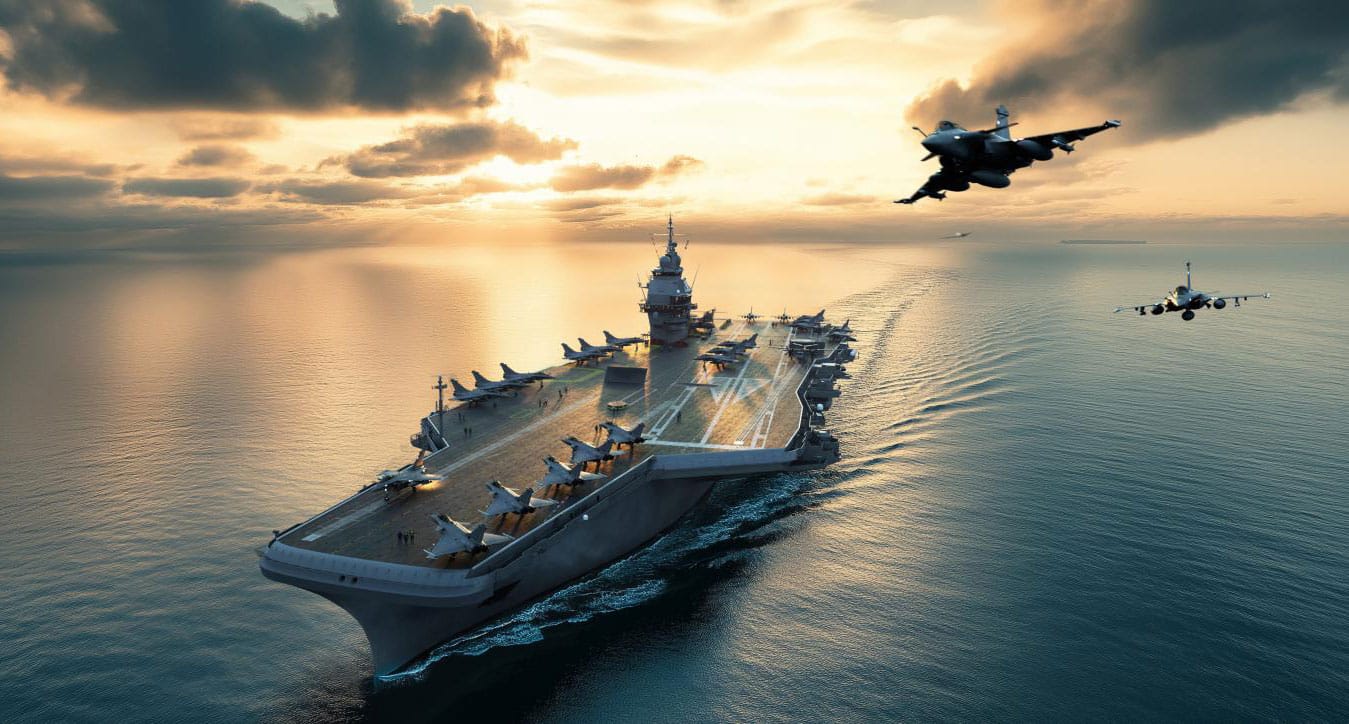
The successor to the aircraft carrier Charles de Gaulle now has a name. France’s next-generation nuclear-powered aircraft carrier (PA-NG) has officially been named “France Libre” by President Emmanuel Macron during a visit to Naval Group’s site in Nantes-Indret, in western France. The head of state travelled to the major French shipbuilding site to formally launch construction of the future French Navy flagship, which is scheduled to put to sea in 2038, as the Charles de Gaulle exits service.
“France Libre: in this name lives the memory of the women and men who stood up to barbarism, united to save our homeland, determined to defend a certain idea of our Nation,” Macron said in his speech, underlining that the choice echoes the legacy of General de Gaulle. “This name therefore seals a pledge for the future: to remain free, we must be feared. To be feared, we must be powerful. To be powerful, we must be ready to make efforts. In these efforts, let us be unyielding, united and tireless,” he added.
The France Libre program was formally contracted by France’s defence procurement agency DGA at the end of last year under the 2024–2030 Military Programming Law (LPM). The cost of the future French nuclear aircraft carrier is currently estimated at around 10 billion euros spread out until its entry into service, a deliberately conservative figure, with roughly 5 billion euros to be funded under the 2024–2030 LPM and the remainder under the following law.
The new carrier will be significantly larger than today’s Charles de Gaulle, with a displacement of nearly 78,000 tonnes versus 42,500 tonnes, an overall length of 310 meters instead of 261 meters, and a beam of up to 80 meters compared with 64 meters. It will embark an air wing broadly similar to that of the Charles de Gaulle, but with greater launch capacity thanks to three EMALS electromagnetic catapults instead of the current two steam catapults. The ship will be powered by two new-generation K22 nuclear reactors, designed to provide greater energy output and allow about ten years of operations between major overhauls, while maximum speed will remain around 27 knots, in line with the Charles de Gaulle.
Naval Group, Chantiers de l’Atlantique and TechnicAtome are the main industrial partners on the program, under the contracting authority of DGA and the French Atomic Energy Commission (CEA), with nearly 800 French companies involved, including more than 600 SMEs and mid-caps. The EMALS catapults remain sourced from US company General Atomics, as on the US Navy’s Gerald R. Ford-class carriers, even though an alternative system would be technically feasible.